
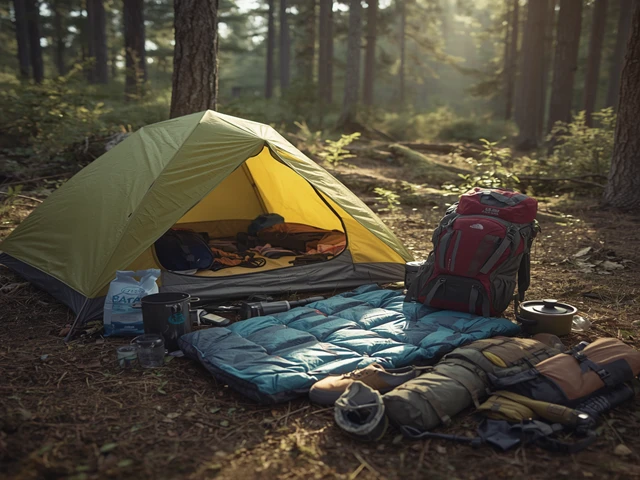
The consequences are so much higher. If you forget your camping gear on a car camping trip, you can try sleeping with extra clothes under you. Three days from the nearest trailhead, that oversight could lead to being too cold to sleep, which could lead to underperforming the next day, which could lead to making mistakes when you’re pitching the next night’s tent, which could lead to potentially life-threatening exposure to the elements.
Build a sleep system, not just a sleeping bag
Most beginners who plan to spend the night in a tent think a lot about the bag they’ll be slumbering in and not much about the pad they’ll be lying on. That’s understandable, especially if you’ve just dropped a chunk of change on an insulated mummy that’ll keep you cozy down to 20°F.
But the truth is, your camping gear is useless without a proper sleeping pad – it won’t keep you warm, comfortable, or functioning the next day. That’s because when you lie directly on a cold surface (i.e., the ground), your body heat gets transferred to that surface by a process called conduction.
R-Value is a measure of resistance to conduction, which basically means the higher the R-Value, the better the pad is at insulating you from the cold ground. And if you’re thinking of skipping on the sleeping pad to save weight… well, don’t. The increase in your metabolism, the body must undertake to keep you warm, without one far outweighing the other.
Choose your shelter for the environment, not the weight chart
Double-wall tents are constructed with two separate layers: an inner tent and a rain fly. The space in between these two layers is where all condensation runs down and out, so you don’t wake up with a wet sleeping bag. In a humid or rainy environment, singles leave you unprotected. Single-wall tents are lighter, smaller, and more packable, which is why some ultralighters love them. But the weight and space savings aren’t worth risking a wet sleeping bag every night or getting caught without shelter.
Illumination is a safety system, not a convenience
Lack of navigation and illumination capabilities is a leading cause of search and rescue missions (National Park Service SAR data). No surprise there. Your best chance of being spotted by searchers in a helicopter, whether you’re lost, injured, or just plain in a hurry, is on an open ridgeline, after dark, with a high-output light.
A headlamp is a task light that keeps your hands free for work. It is a close-range and multipurpose light, whereas a dedicated high-output handheld light is for emergencies and signaling. It’s built for beam distance – identifying a trail marker two hundred feet away in the dark or letting a rescue team know where you are from a ridge.
The Best Flashlights for backcountry use combine high lumen output with a durable IP rating – the ingress protection standard that tells you how well a device resists water and dust intrusion. In a soaking rain at elevation, that rating matters more than the extra ounces. This two-light strategy – headlamp for tasks, handheld for range and signaling – is what backcountry guides and SAR volunteers actually carry.
Food and water planning beyond the ideal scenario
Water filtration cannot be overestimated. The best backup is the hollow-fiber filter: Kin to a drinking straw, you simply stoop and drink. They are the lightest, least labor- and time-intensive, and require no fuel or batteries. UV treatment is the quickest, disabling Giardia, cryptosporidium, and other spoilers in seconds, but it doesn’t work when the water is turbid, and YOU must have the foresight to keep charged batteries on board. Carry both, as this covers more bases than either one.
For some food on the trail, caloric density outranks all. Fat is your friend, and your backup plan should account for stove failures. Pack at least two days of no-cook emergency rations. Stove failures happen – fuel canister issues, wind, equipment damage – and your food plan should account for that without treating it as a crisis.
Navigation should never rely on a single point of failure
GPS satellite communicators provide you with a location and, most importantly, a two-way SOS device that functions even in places where your cell phone won’t get a signal. They use satellite networks instead of cell towers, so they’re really remote-terrain gear.
And they don’t replace physical topographic maps and a baseplate compass. Electronics can fail, run out of battery, or get damaged. Physical maps don’t need charging. Carrying both isn’t excessive; it’s the same logic as the two-light system – each one covers what the other can’t.
The Ten Essentials system survives because the needs haven’t changed: navigation, illumination, shelter, warmth, water, food, and first aid. New camping gear and supplies come out all the time, updating the systems for ways to fill those needs. The key is to be sure that the gear you’re using fits the environment you’ll be in, not the one you wish you’d have.

